
Why Regular Fragrances Fail in Sodium Hypochlorite Cleaning Products
You picked a scent your customers liked. Six weeks into production the batch smells off, and the liquid has gone yellow. If you formulate cleaners with bleach, you have probably watched this happen.
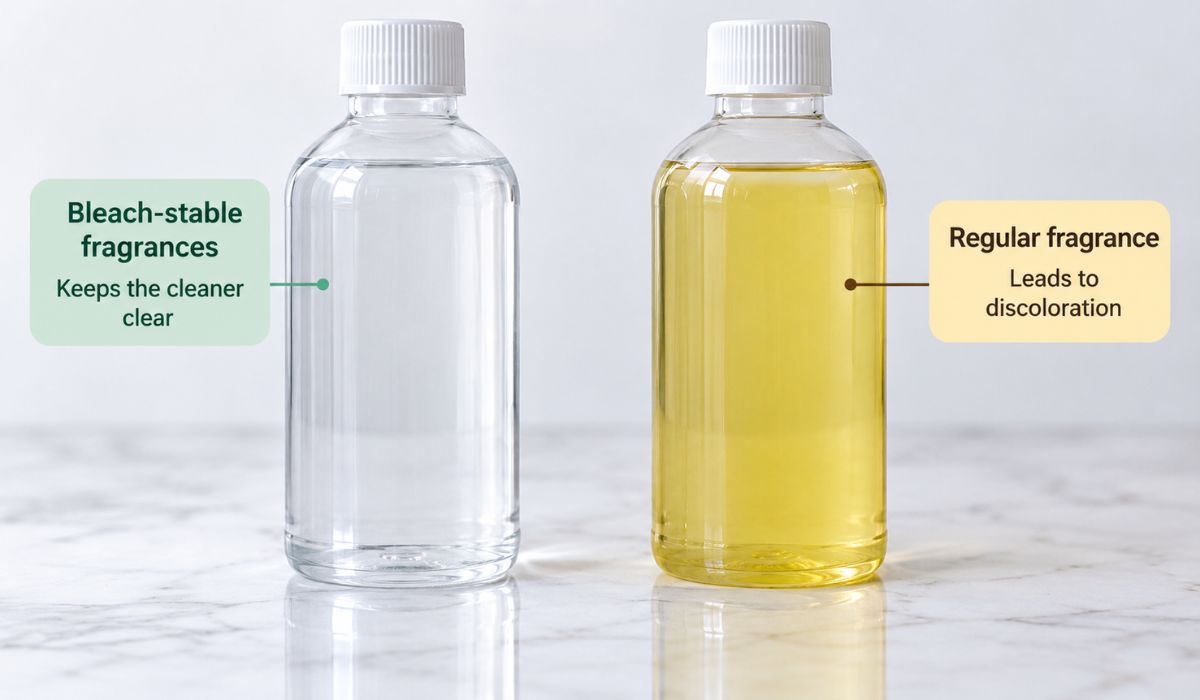
Regular fragrances fail in bleach because sodium hypochlorite is a strong oxidizer that breaks the chemical bonds holding a scent together. The scent fades or turns sour, the color drifts, and the complaints start. Bleach stable fragrances are built to survive that chemistry. Here is what goes wrong, and what to do instead.
What does sodium hypochlorite do to a fragrance?
Sodium hypochlorite oxidizes the aldehydes and unsaturated compounds that give a fragrance its top notes. Those parts break down within days, so the scent goes flat or sour. The same reactions throw off colored byproducts, which turn a clear cleaner yellow or amber.
Sodium hypochlorite is the active ingredient in household bleach, usually at 5% to 8% in consumer products. It is a strong oxidizer, which is exactly why it kills bacteria, fungi, and viruses. That same reactivity goes straight to work on your fragrance.
Most fragrance ingredients are organic molecules built with double bonds, alcohols, and aldehydes. Bleach attacks those bonds. The aldehydes that carry the bright top note oxidize first, so the fresh part of the scent disappears fast. Bleach also runs at a high pH, around 11 to 13, which piles chemical stress on top of the oxidation. What is left smells flat or sour, and the clear liquid you filled last month turns yellow on the shelf. To a shopper, that reads as old or spoiled before anyone opens the cap.
The chlorine smell that tags along
Bleach does not stay quiet in the bottle either. When sodium hypochlorite reacts with dirt, protein, or surfactants during cleaning, it releases volatile compounds that push a sharp chlorine note into the room. A fragrance that already lost its top notes has nothing left to cover it.
Why do bleach stable fragrances hold up?
Bleach and hypochlorite stable fragrances start from a different place. They are built from aroma chemicals chosen for their resistance to oxidation, so they hold up where the reactive aldehydes and alcohols in ordinary fragrances break down on contact. The molecules that stay put under chlorine attack are the ones that make the cut. The payoff is a scent that keeps its profile through mixing, filling, storage, and use. It also helps reduce the harsh chlorine odor itself. At Andrea Aromatics we formulate these fragrances for the exact chemistry they will live in. A scent that survives a thin liquid bleach behaves differently in a thick gel or a solvent cleaner, so we build each one around your base. A catalog scent rarely survives the switch. Fragrance sits in a cleaner at a fraction of a percent, usually 0.1% to 0.5% of the formula, so it has to earn every drop.
Where do bleach stable fragrances get used?
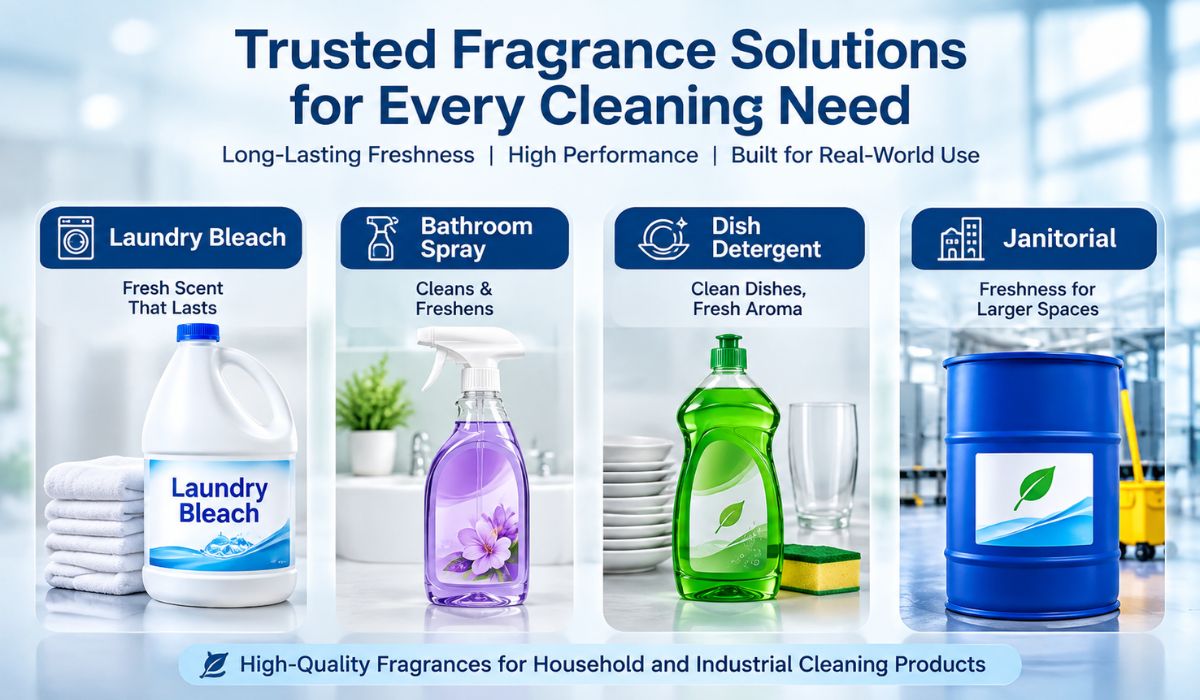
These fragrances cover both consumer and professional lines. The common thread is sodium hypochlorite for applications ranging from household detergents to industrial cleaning applications.
Household bleach and surface cleaners
Laundry bleach, bathroom sprays, toilet bowl cleaners, and multi-purpose sprays sit in the bottle for months. A stable fragrance keeps the scent consistent from first use to last, even in a closed cabinet. This is the core of fragrances for household bleach and industrial cleaning products containing bleach.
Disinfectants and sanitizers
These products live or die on perceived cleanliness. If it smells clean, people treat it as clean. Cleaning product scents that hold up under bleach support that perception without touching the disinfecting power.
Dishwashing detergents
Dishwashing detergents mix bleach, heat, and water, a rough ride for any scent. A bleach stable fragrance handles the high water activity and stays pleasant through the wash, whether the product is a home dish liquid or a commercial machine detergent.
Industrial and institutional cleaning
Hospitals, food processing plants, and large sanitation crews rely on sodium hypochlorite every day. In these industrial applications, holding down the chlorine odor makes the space easier to work in without cutting the product's performance. That comfort matters when people breathe the stuff for a full shift.
What should you check before you commit?
Match the solubility to your base first. Andrea supplies bleach stable fragrances in oil-soluble and water-soluble versions to fit different formulas. Pick the wrong one and the fragrance clouds or separates no matter how stable it is.
Then test in your own base, using the exact formula you plan to ship. Bleach chemistry is unforgiving, and a fragrance that behaves in one formula can misbehave in another. Run an accelerated stability check, then confirm with real-time shelf aging. A short test now saves a recalled batch later.
Get a fragrance that survives your formula
A scent that falls apart in bleach costs you returns, complaints, and reformulation time. The fix is a fragrance designed for the chemistry from day one.
Here is how to find out if we can help:
- Tell us your formulation and the odor problem you are running into.
- We will tell you honestly whether we can help.
- Test a no-obligation sample in your own base.
See the full bleach and hypochlorite stable fragrances page, or contact us to start a sample.
Frequently asked questions
No. These fragrances are chosen to sit alongside sodium hypochlorite without reacting with it, so the active ingredient keeps doing its job.
Accelerated testing gives you an early read in a few weeks. Real-time shelf testing confirms it over the product's life. We can share stability results for the fragrances we supply.
Often, yes. Tell us the scent direction and your base chemistry, and we will work toward a stable version that holds up in bleach.
Yes. Most of our bleach stable fragrances come in oil-soluble and water-soluble forms so they fit the way your product is built.
In-stock fragrances typically ship in 1 to 2 weeks. Custom formulations usually run 3 to 4 weeks, depending on complexity.