
Why your new leather jacket smells like plastic
Modern leather smells like plastic because the protective coatings applied during finishing are polymeric. They seal the hide and block the natural leather aroma from reaching the surface. Manufacturers fix it by adding leather scents formulated for their specific finishing chemistry.
Those coatings are usually polyurethane or acrylic polymer, applied in thin layers after tanning. They protect against water, stains, UV damage, and wear, which is exactly why manufacturers use them. The side effect is that every layer pushes whatever aroma survived tanning further from the surface. By the time the product reaches a retail shelf, what you smell is coating chemistry.
Tanneries solve it with a leather fragrances added during or after finishing. The fragrance has to dissolve in whatever chemistry the process already uses, so leather scents come in four solubilities: finishing oil soluble, alcohol and glycol soluble, water dispersible, and mineral spirit soluble. Match it wrong and the scent won't hold or won't spread evenly. Match it right and the finished piece carries the leather aroma buyers expect, whether that's a car seat, a sofa, or a handbag.
What happened to that classic leather smell?
Pick up a leather jacket from the 1970s and it still smells like leather. Pick up one made last year and there's a good chance it smells like nothing much. Maybe a faint chemical note. Maybe plastic.
Something changed, and it changed in two places: the tannery and the finishing line.
Vegetable tanning, the process that gave leather its characteristic smell for centuries, is slow. Weeks, sometimes months. Chrome tanning takes hours and produces hide that's more uniform and easier to work with at scale. Most of the leather you'll touch today came out of a chrome tannery.
But the bigger change happens after tanning.
The coating problem
After tanning, leather gets a protective coating. Polyurethane or acrylic polymer, applied in thin layers, sometimes several coats. It's a plastic film sitting on the surface of the hide.
That film does its job well. Water, stains, UV, scuffs, all handled.
It also seals in the hide and seals out the smell. Whatever scent survived tanning gets trapped underneath, and each additional coat pushes it further from the surface. What reaches your nose is the coating.
That's the plastic smell.
This runs across the whole industry, from a $50 belt to a $3,000 handbag. Coatings on expensive goods are better made. They're still polymeric, and they still block the scent.
How tanneries put the scent back
Tanneries add a leather fragrance during or after finishing to restore the aroma consumers expect.
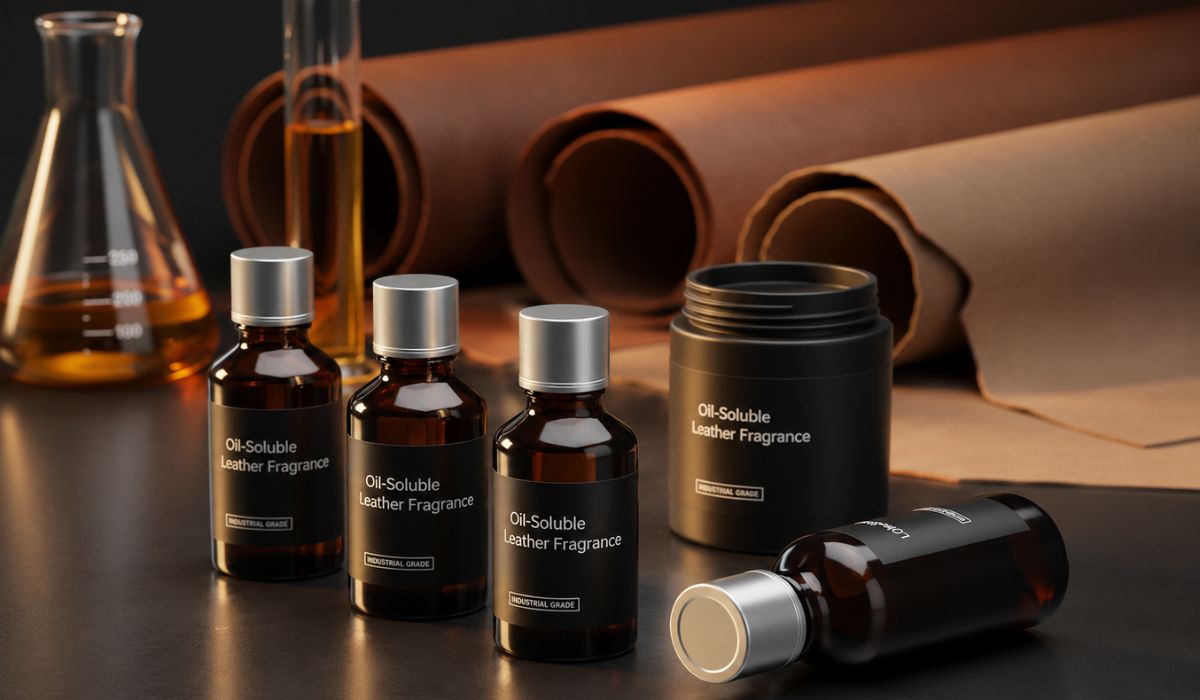
The fragrance has to match the chemistry of the finishing process. A tannery running oil-based finishes needs an oil-soluble scent. One running water-based coatings needs a water-dispersible version. Get it wrong and the scent won't hold, or it spreads unevenly and leaves patches.
Andrea Aromatics has been supplying leather scents to tanneries since 1980. Four formulations, each built for a different finishing chemistry:
- Finishing oil soluble, for oil-based finishes (luxury goods, furniture)
- Alcohol and glycol soluble, for fast-drying systems (automotive, shoes)
- Water dispersible, for water-based treatments
- Mineral spirit and petroleum distillate soluble, for heavy-duty applications (saddles, industrial leather)
Timing matters as much as chemistry. The leather fragrance can go in during tanning, in a final bath, mixed into finishing oils, or sprayed onto completed products. A scent added during tanning bonds deeper into the hide and holds longer. A surface spray is faster and cheaper to apply, and it fades sooner.
Cars, sofas, and everything else made of leather
The plastic-smell problem shows up everywhere leather is used.
Car interiors are the biggest example. That "new car smell" people love is partly engineered. Auto manufacturers specify leather scents for seats, steering wheels, and dashboards, because the alternative is an interior that smells like a coatings plant.
Furniture runs into the same thing. A leather sofa that arrives smelling like a warehouse doesn't read as quality. People judge materials by smell before they check the label.
Sporting goods, toys, shoes, handbags, scented advertising inserts. Any product where leather is part of the brand promise has this problem. The leather aroma is what tells a buyer the thing is real and worth the price.
Vegan leather starts from zero
Natural leather at least starts with a scent and loses it along the way. Synthetic and vegan leather never had one. PU, PVC, and coated fabrics smell like what they are: plastics, adhesives, coatings.
As more brands launch vegan lines, demand for a realistic leather aroma in those materials keeps growing. The job is harder here. A fragrance for synthetic leather has to bond with a substrate far less porous than hide, then survive lamination or heat processing on the way through.
The goal stays the same. A vegan leather handbag that smells like vinyl sends one message to the buyer. One that carries a warm, worn-in leather note sends a very different one.
Frequently asked questions
Because of the coatings. Modern leather gets finished with polyurethane or acrylic polymers that shield it against water, stains, and wear. Those coatings block the natural leather aroma from reaching the surface. What you're smelling is the finish.
The coatings are standard across the industry and generally considered safe for consumer use. The smell comes from the polymeric finish itself. Still, a strong chemical odor on any product is worth raising with the manufacturer if it bothers you.
Airing the product out in a well-ventilated space for a few days will reduce the coating smell. Baking soda or a vinegar wipe helps some people. Those are surface fixes though. They won't put a leather scent back, because the aroma was stripped during manufacturing. Restoring it takes a leather fragrance formulated for the job and applied on the production line.
It depends on the product. Fragrance added during tanning absorbs deeper into the hide and lasts longer. Adding it to the final finishing bath or mixing it into finishing oils gives good results with less material. Spraying completed goods is the easiest method and fades fastest. Match the choice to how the product gets used and how long the scent needs to last.
Yes. The fragrance has to dissolve in whatever finishing chemistry your process uses. An oil-soluble scent won't work in a water-based system, and the reverse is equally true. Andrea Aromatics makes four versions, each matched to a different finishing process. See our leather scents product page for the full breakdown.
Yes. Andrea Aromatics formulates a leather fragrance for PU, PVC, and coated fabric substrates. The chemistry differs from natural leather because synthetic materials are less porous, so the fragrance needs fixatives to help it hold on the surface. The result is a realistic leather scent on a product that never came from an animal hide.
Request a sample and run it through your actual production line. What smells right in a bottle can behave differently once it's bonded to leather and gone through curing. Andrea Aromatics provides no-obligation samples, so you can test before committing to a production order.